
Wood Laminate Sheets: Designs, Benefits, and Applications
September 8, 2026
Glossy Laminates: Finishes, Benefits, and Design Ideas
October 5, 2026
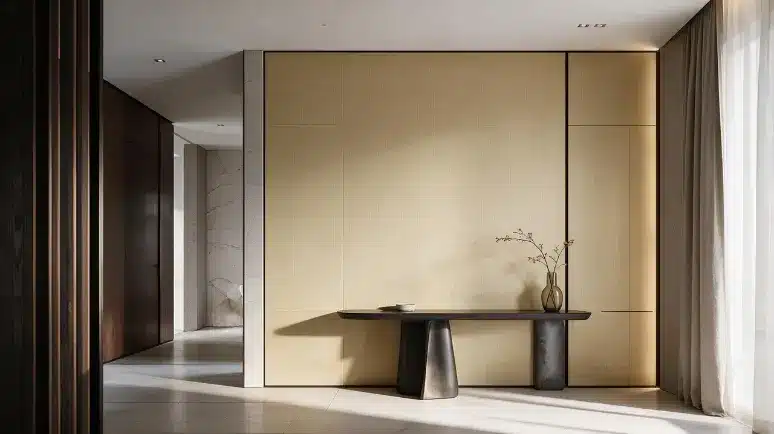
Given all the time I’ve spent working with laminate sheets, talking to carpenters, and going through catalogues without end, there’s one thing I’m certain of: no one actually selects a laminate finish on the first attempt. At least, that’s how it seems. You think you know what matte oak looks like until you find yourself in a showroom with the fluorescent lights on; at that point it looks completely different from the sample that your carpenter showed you at home. That’s the way it is.
The truth is that a laminate finish is simply paper and resin pressed together with heat. It does sound rather unimpressive when put like that. Yet if it’s done properly, it can deceive almost anybody into believing that your wardrobe is actually solid teak or that your kitchen counter is made of stone.
This isn’t a spec sheet. It’s what I’ve learned picking these finishes for kitchens, wardrobes, and everything in between.
Let’s get into it.
Laminate Texture Options for Contemporary Interiors
Contemporary doesn’t mean boring. People assume it does. Clean lines, sure. But the surfaces underneath those lines have gotten a lot more interesting over the last decade.
In the old days, they used to offer just plain colour; that was all. These days it’s matte, satin, and metallic touches, and there are even wood-effect panels which are good enough to deceive your eye from three feet away. There are now so many choices, and frankly that is both an advantage and a pain when you’re the one having to make the decision.
A few finish types that keep coming up in contemporary spaces:
- For kitchens and wardrobes where a calm appearance rather than a busy one is desired, matte and satin finishes are the safest choice.
- Metallic and decorative metal accents, used sparingly because too much and a room starts looking like an appliance store.
- Wood-effect surfaces, still the most requested option by a wide margin.
- Solid, plain colours, for people who want the room to breathe.
- Textured surfaces, which add depth without shouting for attention.
Formica India makes a strong push into this area with its FENIX range, and this is evident. The matte finish, which has been treated with nanotechnology, resists both fingerprints and minor scratches, even though it sounds just like advertising until you actually slide your hand over it after having used it for a week in a busy kitchen. It does hold up. In contrast, the DecoMetal range takes a completely different approach by focusing on metal finishes with an industrial look that is appropriate for loft-style apartments and modern offices.
The following point is one that isn’t mentioned at the beginning: laminates are the result of engineering rather than being natural. In fact, that’s their benefit. If you buy the same sheet six months later, it will match. With real stone or timber, you can’t reliably do this. When it comes to large-scale projects, such as hotels or offices, where you need forty identical wardrobe shutters, the importance of consistency is something people only realise when they’re the ones having to cope with mismatched batches.
Wood Laminate Texture and Natural Wood Effects
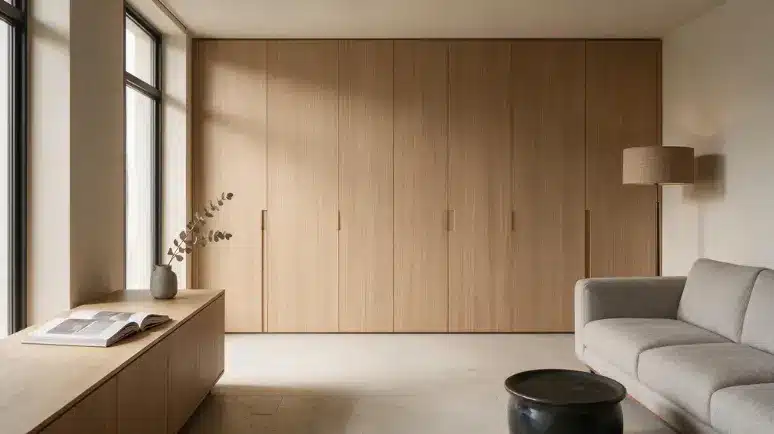
Ask any carpenter what clients ask for first, and it’s wood every time. There’s something about a wood laminate texture that feels warmer, more lived-in, than anything else on the shelf.
The good ones aren’t just brown with lines painted on. They replicate actual grain direction, knots, and the colour shifts you see in real teak, walnut, or oak. Get close, and it’s still convincing, which says a lot about how far the printing technology has come.
A few things separate a good wood-effect sheet from a mediocre one:
Feature: What It Does
- Grain-direction printing: Follows how real wood actually grows and flows.
- Embossed or textured surface: Gives it depth, so your hand feels wood, not paper.
- UV-resistant top layer: Keeps the colour from fading under sunlight.
- Scratch-resistant coating: Handles the daily wear, kids, bags, keys, and all of it.
The legacy laminate range covers a lot of this ground well. And if you want to go further up the ladder, there’s Formica Ligna, which uses actual wood veneer bonded onto the laminate base. It’s not cheap, but it’s about as close to solid timber as you’ll get without paying solid timber prices.
Here’s the kicker, though. This kind of wood-effect surface doesn’t warp. It doesn’t get eaten by termites. It doesn’t need re-polishing every few years as real wood does. You lose a little bit of “authenticity”, sure, but you gain decades of not worrying about it. For most people, that trade is worth making.
Textured Laminate Sheets for Furniture Surfaces
Furniture takes a beating. Nobody thinks about this until their glossy wardrobe shutter is covered in fingerprints two weeks after installation. That’s when people start asking about textured laminate sheets instead.
It’s not only a matter of appearance, since it also has to do with grip and the extent to which the surface absorbs shocks when a child touches it with dirty hands or when you’re moving furniture and something scrapes against it. With flat, shiny sheets, all details are revealed, whereas texture conceals a great deal.
Where you’ll typically find these:
- Wardrobe shutters and sliding doors
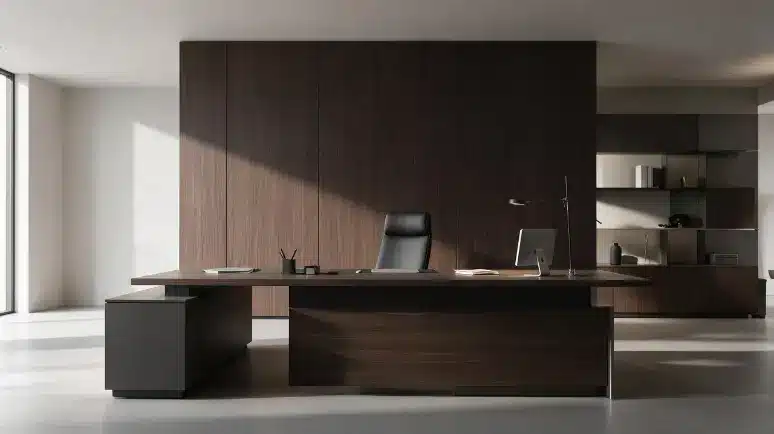
- Study tables and office desks
- Kitchen cabinet fronts
- TV units and storage furniture
- Bathroom vanities, where moisture resistance matters as much as texture
Matte-finish products like the FENIX line sit right at the centre of this shift. The advanced nanotechnology coating resists fingerprints and micro-scratching in a way that older glossy laminates simply couldn’t. It’s not magic. It’s just better materials science applied to a problem people have complained about for years.
There’s a practical side too. These textured surfaces scatter light instead of bouncing it straight back at you, so dust and light surface marks don’t announce themselves the way they do on a glossy surface. And most of these sheets come in multiple thicknesses now, standard grades for cabinetry, and thicker compact grades for anything that takes a real beating, like dining tables or kitchen counters.
Matt, Gloss and Embossed Laminate Textures
Every client asks the same question eventually: matte or glossy? And the honest answer is, it depends on how much you’re willing to clean.
Matte finishes hide fingerprints and smudges shockingly well. That’s why kitchens and wardrobes lean matte so heavily these days. It also just feels warmer, less like you’re touching plastic. The FENIX range takes this further, using nanotechnology to resist both fingerprints and micro-scratches, which is genuinely useful in a house with kids or pets.
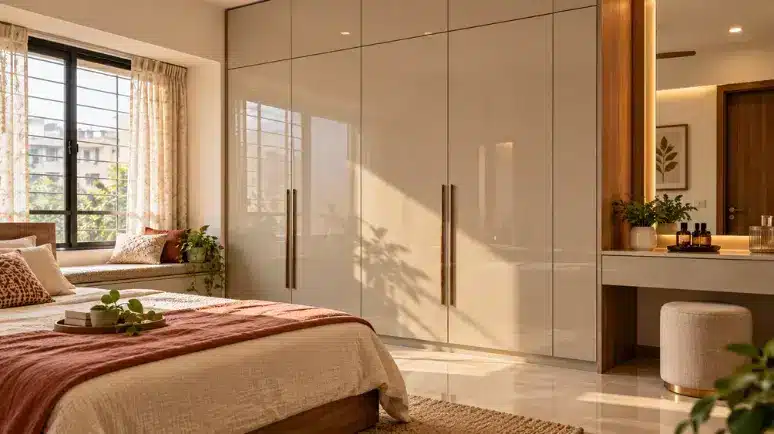
Glossy surfaces offer the opposite value proposition. They reflect light beautifully, making the enclosed space appear bright. But they also spotlight smudges, making them very hard to ignore. This requires more frequent cleaning.
Other than that, there is the option of textures. Textured surfaces offer 3D valence that makes them appear interesting close up. This category is growing because, simply put, the eye can be fooled into thinking something is 3D when it is not.
| Finish Type | Best Suited For | Maintenance Level |
| Matte | Modern kitchens, wardrobes, offices | Low |
| Glossy | Statement walls, feature accents | Medium to High |
| Textured | Mixed-style interiors, feature panels | Low to Medium |
Cleaning, honestly, isn’t complicated. A damp cloth handles most of it. Skip the harsh chemicals and abrasive scrubbers, though. They’ll dull the protective coating faster than daily use ever will, and once that coating goes, the surface underneath starts showing its age fast.
Popular Patterns and Surface Effects in Laminates
Pattern is where people either nail the room or completely overthink it. There’s no shortage of options, and that’s exactly the problem.
Some directions that keep showing up in projects lately:
- Woodgrain, the evergreen choice, mimicking real timber grain
- Solid colours, from muted neutrals to genuinely bold statement shades
- Subtle surface textures, adding depth without a loud pattern
- Metal finishes, for anyone chasing an industrial look
- Earth tones, calm and grounding, especially in bedrooms
- Minimal-grain matte surfaces, for people who want understated over decorative
Formica India has a number of ranges covering this area with very little overlap. FENIX is at the top end and uses sustainable materials along with having finely tuned matte colour options, making it suitable for high-performance environments. VIS is the more budget-friendly option as well and is sustainable, although it is priced to suit people who are watching their expenditure. Cora takes cost, practicality and durability even further, without aiming for a luxury finish. As its name indicates, DecoMetal looks after the metal-finish sector for those who want that industrial touch.
The fact is that the “correct” pattern completely depends on the room you have. The effect of natural light makes all the difference; a pattern which looks wonderful in a north-facing showroom can appear flat and lifeless in your real west-facing bedroom. Therefore, you should take the samples home and look at them in the morning and then again in the evening. It doesn’t seem like a great idea until after you’ve made the error of omitting it once.
Laminate Textures for Kitchens, Wardrobes and Furniture
Different rooms, different rules. What works beautifully in a wardrobe can be the wrong call entirely in a kitchen.
Kitchens take the most abuse of any surface in the house. Grease, steam, splashes, daily wear. Matte and lightly textured finishes handle this better than glossy ones, hiding the mess instead of highlighting it. A wood-look finish on a kitchen island adds warmth to what’s otherwise a purely functional space, and moisture-resistant grades near the sink and hob are non-negotiable if you don’t want to be fighting warped panels within a year.
Wardrobes are examined in detail every single day, a kind of inspection different from that of a kitchen counter. Textured and matte finishes tend to be the preferred choice for this reason. The range available across FENIX, VIS, and Cora allows you to choose in terms of both style and budget. There’s also a small point that’s worth knowing: in a small bedroom, darker shades of wardrobe shutters have the effect of making the room seem more grounded, while a lighter finish has the effect of making the space appear larger. It’s the same room, but with a completely different atmosphere, simply because of the shutter finish.
Furniture such as study tables, TV units, and shelving has to be able to cope with books, bags, and all the other things that are dropped on it. Instead of smooth sheets, textured ones cope much better with this kind of everyday use. Cora provides good durability without the high price, whereas FENIX offers additional scratch resistance for items that are used more heavily.
A habit you should develop is to look at samples in the same lighting as your actual room, not in the lighting of the showroom. The way colours and the texture of the laminate change when going from artificial to natural light is more than most people anticipate. Even Formica India, among the major suppliers, groups its ranges according to room type, a practice which honestly cuts down considerably on the back-and-forth involved when you’re narrowing your choices.
FAQs
The word ‘better’ is very wrong. Every situation is different. The matte finish would hide fingerprints and smudges if you have kids or you just hate cleaning your walls every night. On the other hand, the glossy finish would brighten up your room, so it would be great if you have a small and dark room. Neither is better; it’s a matter of how much you want to clean.
Mostly, yes. The finish resists scratches and doesn’t fade the way cheap prints do, and it won’t warp or attract termites the way solid timber can. That said, it’s still a surface, not armour. Drag something sharp across it hard enough and it’ll show. Day to day use, though, it holds its own for years without much fuss.
Honestly not much work needed. A damp cloth after using it is usually enough. Avoid the scouring pads and cleaners that have bleach in them; they damage the top layer more quickly than normal use does. Once that layer is gone, the surface beneath starts getting stains. Scratches much faster.

1 Comment
That was amazing